
RGB Protocol on Bitcoin Is Live on Mainnet — Core Concepts Updated
RGB Protocol on Bitcoin — in brief: Launched on Bitcoin mainnet in July 2025 (v0.11.1) — the first production-ready release...
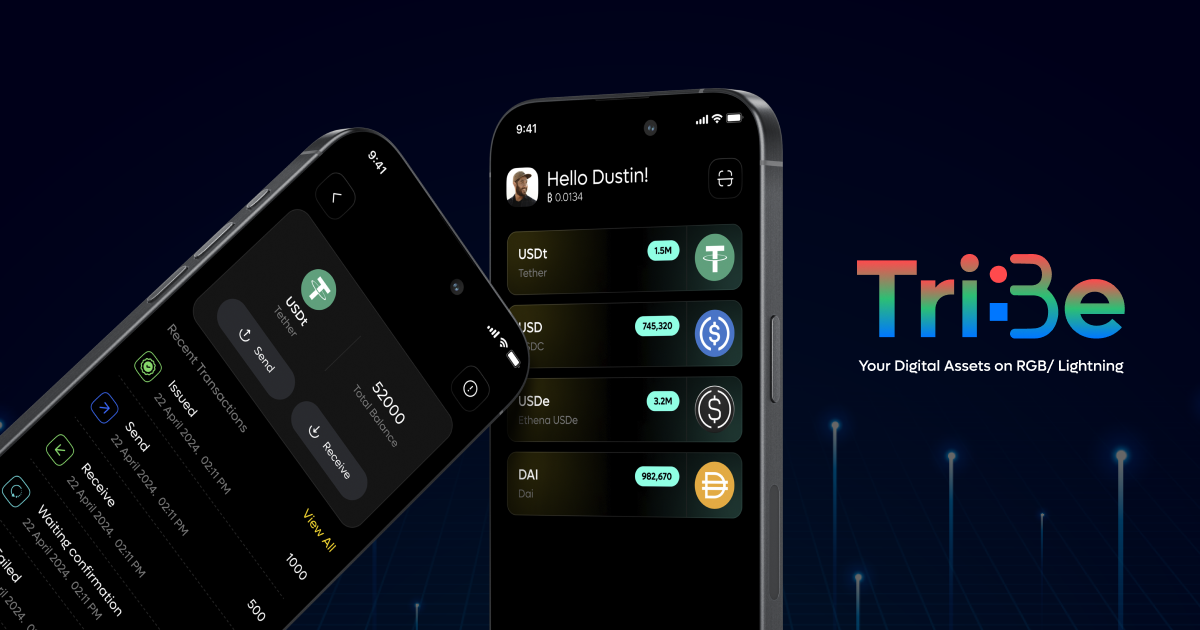
RGB Protocol on Bitcoin — in brief:
- Launched on Bitcoin mainnet in July 2025 (v0.11.1) — the first production-ready release.
- Uses client-side validation: asset data stays private and off-chain, only a cryptographic commitment goes on Bitcoin.
- Tribe RGB is live on mainnet with full v0.11.1 support.
- Canonical source: rgb.info — documentation: docs.rgb.info.
When we published our earlier article on the core concepts of RGB, the protocol was in active development. We were building Tribe to be ready for the moment it hit production. In July 2025, that moment arrived: RGB Protocol on Bitcoin v0.11.1 went live on mainnet, and Tribe launched alongside it.
The framing changes entirely. RGB is not a relatively new technology in active development anymore. On the contrary, it is now a production-ready protocol, stable and documented, with a full ecosystem built on it, including us. This post updates the core concepts with what is accurate today and corrects one technical error in the original.
Client-Side Validation
At the heart of RGB Protocol on Bitcoin lies client-side validation. Unlike traditional blockchain-based smart contract systems, RGB keeps all contract data off-chain.
When two parties transfer an RGB asset, they exchange the asset data directly, peer-to-peer. Bitcoin only records a small cryptographic commitment, just a few bytes embedded in a standard Bitcoin transaction, to confirm the transfer happened. The asset data itself stays entirely off-chain, between the parties involved.
What this means in practice for Tribe users:
- Your balances are invisible on-chain. No one scanning the blockchain can see what you hold or who you have sent assets to.
- Bitcoin stays lean. RGB data never lands on-chain. Only a compact cryptographic proof does.
- Instant transfers on Lightning. Tribe can move RGB assets through Lightning channels in milliseconds, at near-zero cost.
- You verify, not the network. Your wallet validates the full ownership history locally.
Single-Use Seals
RGB Protocol on Bitcoin uses single-use seals defined over Bitcoin UTXOs. Each seal represents asset ownership or a contract state. When a transfer occurs, the current seal is closed and a new one is created at the recipient’s UTXO.
This mechanism prevents double-spending by binding each RGB asset to a specific Bitcoin UTXO. An asset cannot be transferred twice, as long as the underlying Bitcoin transaction is valid.
In Tribe, every asset in your wallet is locked to a specific Bitcoin UTXO. When you send it, that UTXO is spent, so the seal closes and a new one opens at the recipient’s end.
The DAG Structure — A Correction
Our original article stated: Each new transaction requires confirmation from at least two previous transactions. This part is incorrect and needs to be clarified.
RGB smart contracts are represented as a Directed Acyclic Graph (DAG) of state transitions, meaning the history of a contract forms a graph with no cycles. Each state transition references the previous state it transitions from.
RGB Protocol on Bitcoin has no independent consensus layer. It uses Bitcoin’s blockchain for timestamping commitments. Bitcoin’s security is the foundation, not a separate confirmation system.
The DAG structure in RGB means:
- Participants only know the portions of the contract history relevant to them.
- Contract history cannot be rewritten or cycled back.
- The full state history of an asset can be verified locally by the recipient.
What Launched with RGB v0.11.1
In July 2025, RGB Protocol on Bitcoin v0.11.1 reached mainnet. We launched Tribe together with it, with a version that was fully compatible with v0.11.1 from day one.
- Tribe RGB — self-custody Bitcoin and RGB asset wallet on iOS and Android, with Lightning support.
- Iris Wallet — mobile wallet with full RGB Lightning support.
- BitMask — browser extension wallet for RGB assets, developed by DIBA.
- KaleidoSwap — decentralized exchange for RGB assets on Lightning.
- LNFI Network — DeFi infrastructure for RGB assets on Lightning.
- Utexo — B2B settlement infrastructure for USDT via RGB and Lightning.
- BiHelix — application framework for issuing assets on Bitcoin via RGB.
Tether Is Bringing USDT to RGB
In August 2025, Tether announced plans to launch USDT on RGB Protocol on Bitcoin. USDT would exist natively on Bitcoin for the first time — validated privately through client-side validation, transferable over Lightning, without sidechains or custodians.
For Tribe users, the implication is direct: when USDT launches on RGB mainnet, you will be able to hold, send, and receive it natively in Tribe over Lightning, with no bridges, no custodians, and no sidechain.
What You Can Hold and Issue with Tribe
RGB defines multiple asset types through schemas. Tribe supports four of them out of the box:
- NIA (Non-Inflatable Asset) — fungible token with a fixed supply set at issuance.
- IFA (Inflatable Fungible Asset) — fungible token with a defined inflation cap.
- CFA (Collectible Fungible Asset) — collectibles with optional metadata per issuance.
- UDA (Unique Digital Asset) — non-fungible, unique, and indivisible.
Where to Learn More
Tribe RGB is available on iOS and Android. Download it, hold your first RGB asset, and see client-side validation in practice in a way that needs no bridges, no custodians, just Bitcoin.
- Official site: rgb.info
- Technical documentation: docs.rgb.info
- Code: github.com/rgb-protocol and github.com/RGB-Tools
- RGB Protocol Association: rgbprotocol.org